
How to Reduce Manual Billing Errors in Housing Societies

Connected Hood Team
The Connected Hood team shares expert insights on society management and community living in India.January 8, 2026
7 min read
Discover common billing mistakes in housing societies and learn how automated billing software can eliminate errors, save time, and improve resident satisfaction.
#How to Reduce Manual Billing Errors in Housing Societies
Every month, thousands of Resident Welfare Associations (RWAs) across India struggle with the same problem: billing errors. From miscalculated maintenance charges to missing payments, manual billing processes create friction between management committees and residents. According to a survey by the Federation of Apartment Owners' Associations, nearly 40% of resident complaints in housing societies stem from billing-related issues.
If your society is still relying on spreadsheets, registers, or manual calculations, this guide will help you understand the true cost of billing errors and how to eliminate them.
#Common Manual Billing Errors That Plague Housing Societies
#1. Calculation Mistakes
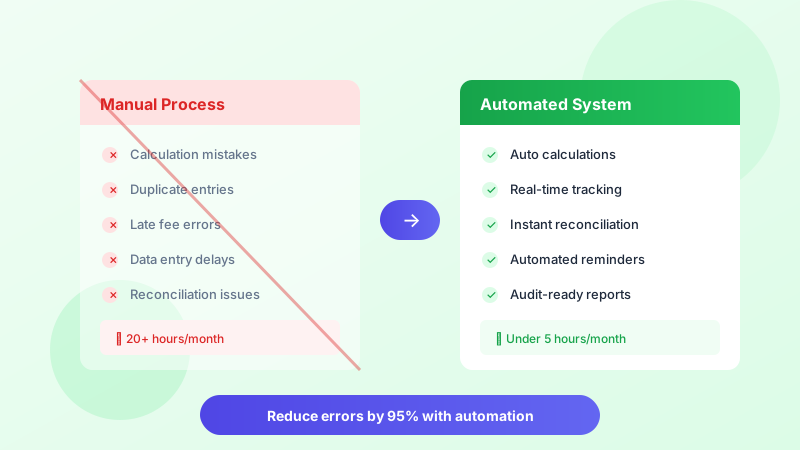
When treasurers manually calculate maintenance charges based on carpet area, parking slots, and additional services, errors are inevitable. A simple decimal point mistake or formula error can cascade across hundreds of flats, leading to undercharging some residents while overcharging others.
Example: A society in Pune discovered they had been undercharging 15 flats by Rs. 200 each for 18 months due to a spreadsheet formula error. The committee faced significant backlash when trying to recover Rs. 54,000 in arrears.
#2. Duplicate or Missing Entries
Manual systems make it easy to accidentally record a payment twice or miss it entirely. When residents pay through multiple channels (UPI, bank transfer, cheque), tracking becomes chaotic without a unified system.
#3. Late Fee Calculation Errors
Interest on delayed payments must be calculated accurately and consistently. Manual calculations often lead to:
- Inconsistent penalty rates for different residents
- Incorrect compounding of interest
- Missed penalty applications altogether
#4. Data Entry Delays
When the treasurer is unavailable or busy, payment updates get delayed. Residents receive reminders for bills they have already paid, eroding trust in the management.
#5. Reconciliation Nightmares
Matching bank statements with society records becomes a monthly ordeal. Mismatched entries mean hours spent tracking down discrepancies instead of focusing on community improvements.
#The Real Impact of Billing Errors on Your Society
#Financial Losses
Billing errors do not just create inconvenience; they directly impact your society's finances:
- Revenue leakage: Undercharging even Rs. 100 per flat across 200 flats means Rs. 20,000 lost monthly
- Uncollected arrears: Poor tracking leads to forgotten outstanding dues
- Audit complications: Errors create problems during annual audits and statutory compliance
#Resident Dissatisfaction
Nothing frustrates residents more than receiving incorrect bills or being charged for payments already made. This leads to:
- Increased complaints and disputes
- Delayed payments as residents wait for corrections
- Erosion of trust in the management committee
- Heated AGM discussions instead of productive planning
#Committee Burnout
Volunteer committee members spend countless hours fixing billing issues instead of improving community living. This thankless task often leads to:
- Difficulty finding volunteers for future committees
- High turnover in key positions
- Poor institutional knowledge transfer
#Digital Solutions: The Path to Error-Free Billing
Modern society management software offers comprehensive solutions to eliminate manual billing errors. Here is what to look for:
#Automated Bill Generation
The software should automatically calculate monthly charges based on predefined rules:
- Area-based calculations: Maintenance charges computed from carpet area data stored in the system
- Slab-based pricing: Different rates for different flat sizes or types
- Add-on services: Automatic inclusion of parking, club membership, and other charges
- Prorated calculations: Accurate billing for mid-month occupancy changes
#Real-Time Payment Tracking
A good billing system should:
- Integrate with payment gateways: Accept UPI, cards, and net banking with automatic reconciliation
- Match bank statements: Auto-import and match transactions
- Send instant receipts: Residents receive confirmation immediately upon payment
- Update ledgers automatically: No manual entry required
#Intelligent Reminders and Escalations
Automated reminders ensure:
- Pre-due date notifications via SMS, email, and app notifications
- Customizable escalation for persistent defaulters
- Consistent communication without manual follow-up
#Audit-Ready Reports
Digital systems generate:
- Member-wise ledger statements
- Collection reports by period
- Outstanding dues analysis
- Interest calculation breakdowns
- GST-compliant invoices where applicable
#Implementation Tips for Your Society
#Step 1: Audit Your Current Process
Before switching to software, document your existing billing structure:
- List all charge components
- Document calculation formulas
- Identify current pain points
- Note the average time spent on billing monthly
#Step 2: Clean Your Data
Migrating to a new system is the perfect opportunity to clean up:
- Verify flat ownership records
- Reconcile outstanding balances
- Standardize naming conventions
- Archive historical data properly
#Step 3: Choose the Right Software
Evaluate options based on:
- Ease of use: Committee members should need minimal training
- Indian context: Support for RWA-specific requirements
- Integration: Payment gateway compatibility
- Support: Responsive customer service in your language
- Scalability: Can grow with your society's needs
#Step 4: Communicate the Change
Prepare residents for the transition:
- Announce the change at a general meeting
- Provide tutorials for online payment
- Offer support for elderly residents
- Set a clear go-live date
#Step 5: Run Parallel Systems Initially
For the first two to three months, run both old and new systems to:
- Verify accuracy of automated calculations
- Build confidence in the new process
- Identify any edge cases that need configuration
#Measuring Success After Implementation
Track these metrics to ensure your digital transformation is working:
| Metric | Manual Process | Target with Automation | |--------|---------------|----------------------| | Bill generation time | 2-3 days | Under 1 hour | | Payment reconciliation | Weekly | Real-time | | Billing-related complaints | 15-20 per month | Under 5 per month | | Outstanding collection rate | 70-80% | Above 90% | | Time spent on billing | 20+ hours/month | Under 5 hours/month |
#Frequently Asked Questions
#How much does society billing software typically cost?
Most society management apps in India charge between Rs. 1,000 to Rs. 5,000 per month based on the number of flats. Some offer per-flat pricing starting at Rs. 5-15 per flat monthly. The cost savings from reduced errors and time typically justify the investment within months.
#Can elderly residents who are not tech-savvy still pay their bills?
Yes, good software provides multiple payment options including bank transfers. Committee members can also accept cash or cheques and update the system on behalf of residents.
#What happens to our historical billing data?
Most software providers help migrate historical data during onboarding. Ensure you keep backups of old records for at least seven years as per accounting best practices.
#How secure is online billing data?
Reputable society management apps use bank-grade encryption and comply with data protection standards. Always choose providers with clear security certifications and privacy policies.
Ready to Transform Your Society Management?
Connected Hood makes managing your residential community effortless. From visitor management to billing automation, experience the difference.
#Conclusion
Manual billing errors are not just minor inconveniences; they drain your society's resources, damage trust, and burden volunteer committee members. In 2026, there is simply no reason for housing societies to continue struggling with spreadsheets and registers when affordable, India-specific solutions are readily available.
The societies that embrace digital billing are not just reducing errors; they are freeing up time and energy to focus on what truly matters: building better communities. If your society is still battling monthly billing chaos, now is the time to make the switch.
Ready to eliminate billing errors in your society? Explore how Connected Hood can transform your billing process with automated calculations, real-time tracking, and hassle-free payments.
Related Articles
Society Accounting Made Simple: Compliance and Best Practices for RWAs
Getting Started with Society Billing: A Complete Guide
Top 10 Must-Have Features in a Society Management App