
Society Accounting Made Simple: Compliance and Best Practices for RWAs

Connected Hood Team
The Connected Hood team shares expert insights on society management and community living in India.January 20, 2026
10 min read
Master housing society accounting with this guide to compliance requirements, best practices, digital accounting benefits, and common mistakes to avoid.
#Society Accounting Made Simple: Compliance and Best Practices for RWAs
Money matters cause more conflict in housing societies than any other issue. Transparent, accurate accounting is not just good practice—it is essential for maintaining trust, ensuring compliance, and protecting the committee from accusations of mismanagement.
Yet, many Resident Welfare Associations (RWAs) and cooperative housing societies struggle with accounting. Volunteer treasurers may lack accounting knowledge, compliance requirements are often unclear, and traditional methods cannot handle modern complexity.
This guide simplifies society accounting, covering legal requirements, best practices, the benefits of digital accounting, and common mistakes that get societies into trouble.
#Understanding Society Accounting Fundamentals
#Types of Housing Society Structures
Accounting requirements vary based on your society's legal structure:
Cooperative Housing Society:
- Registered under state Cooperative Societies Act
- Governed by cooperative society rules
- Subject to audit by cooperative department
- Must maintain prescribed registers and accounts
Resident Welfare Association (RWA):
- Registered under Societies Registration Act or as Trust
- More flexible governance structure
- Annual filing requirements vary by state
- Self-regulated accounting with audit requirements
Apartment Owners' Association:
- Formed under state Apartment Ownership Acts
- Requirements specified in declaration/bye-laws
- Usually requires annual audit
- Financial transparency to members mandatory
#Key Financial Statements
Every society should maintain:
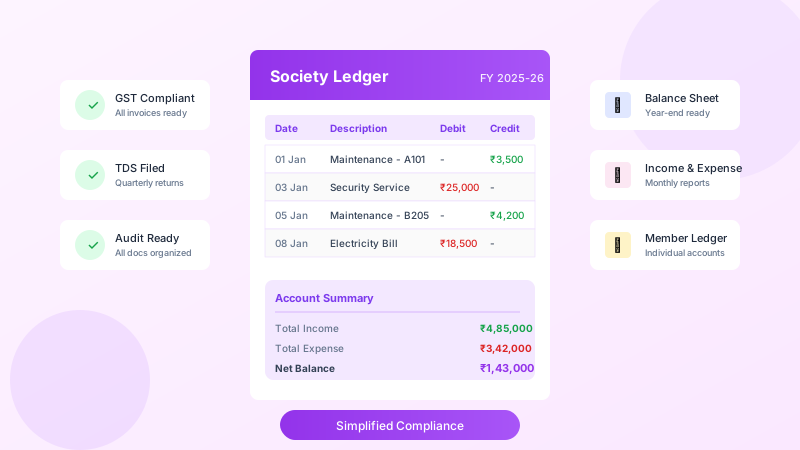
Income and Expenditure Account:
- Records all income received during the year
- Records all expenses incurred
- Shows surplus or deficit for the period
- Equivalent to profit and loss statement
Balance Sheet:
- Shows society's assets (what it owns)
- Shows liabilities (what it owes)
- Shows accumulated funds
- Snapshot of financial position at year-end
Receipt and Payment Account:
- Cash-based record of all money received and paid
- Important for cash flow management
- Reconciles with bank statements
- Useful for audit verification
Member Ledgers:
- Individual account for each flat/member
- Shows charges, payments, and balance
- Must be available to respective members
- Essential for collection tracking
#Compliance Requirements
#Statutory Compliance
GST Considerations:
- Societies with turnover exceeding Rs. 20 lakh may need GST registration
- Maintenance charges above Rs. 7,500 per month may attract GST
- Interest on delayed payments may be taxable
- Commercial rentals from society property are taxable
Income Tax:
- Societies are generally assessed as Association of Persons (AOP)
- Mutual contributions (maintenance from members) usually exempt
- Income from non-members (rentals, interest on FDs) may be taxable
- TDS obligations on payments to contractors and professionals
State-Specific Requirements:
- Cooperative societies must follow state cooperative rules
- Some states require specific registers and formats
- Filing deadlines vary by state
- Penalties for non-compliance can be significant
#Audit Requirements
Cooperative Societies:
- Annual audit mandatory
- Must be conducted by auditor empaneled with cooperative department
- Audit observations must be addressed
- Audit report filed with registrar
RWAs and Other Structures:
- Audit requirements depend on bye-laws
- Usually annual audit by qualified CA
- Report presented at AGM
- Members have right to inspect books
#Documentation Requirements
Mandatory Registers (for Cooperative Societies):
- Cash book
- Ledger
- Member register
- Share register
- Minutes book
- Property register
Recommended Records (for all societies):
- Vouchers with supporting documents
- Bank statements and reconciliations
- Contracts and agreements
- Insurance policies
- Tax returns and assessments
#Accounting Best Practices
#1. Maintain Proper Chart of Accounts
Organize your accounts systematically:
Income Accounts:
- Maintenance charges - Regular
- Maintenance charges - Commercial
- Interest on investments
- Interest on delayed payments
- Parking charges
- Amenity booking fees
- Other income
Expense Accounts:
- Salaries and wages
- Security services
- Housekeeping services
- Electricity - Common areas
- Water charges
- Repairs and maintenance
- Professional fees
- Insurance
- Administrative expenses
Asset Accounts:
- Bank accounts (list each)
- Fixed deposits
- Receivables from members
- Advance payments
- Fixed assets
Liability Accounts:
- Payables to vendors
- Security deposits from members
- Advance maintenance received
- Statutory dues payable
Fund Accounts:
- General fund
- Sinking fund
- Reserve fund
- Specific purpose funds
#2. Implement Internal Controls
Segregation of Duties:
- Different people for authorization, recording, and custody
- Secretary approves expenses, treasurer records, accountant reconciles
- No single person controls entire transaction cycle
Authorization Limits:
- Define spending limits for different roles
- Major expenses require committee approval
- Capital expenditure needs AGM approval
- Emergency spending protocols documented
Documentation Standards:
- Every transaction supported by documents
- Vouchers numbered sequentially
- Approvals documented before payment
- Original documents retained, not photocopies
Bank Account Controls:
- Dual signatory requirement for cheques
- Regular bank reconciliation
- Separate accounts for different funds
- No cash payments above prescribed limits
#3. Budget and Track
Annual Budgeting:
- Prepare realistic budget before financial year
- Get AGM approval for major allocations
- Include provision for contingencies
- Budget for capital expenditure separately
Variance Analysis:
- Monthly comparison of actual vs budget
- Investigate significant variances
- Report variances to committee
- Adjust operations as needed
#4. Receivables Management
Billing Accuracy:
- Generate bills on time every month
- Ensure calculations are correct
- Include all applicable charges
- Provide clear breakdowns
Collection Follow-Up:
- Send reminders before and after due date
- Apply interest consistently per bye-laws
- Escalate persistent defaulters
- Document all collection efforts
Defaulter Management:
- Clear policy for handling defaults
- Progressive escalation approach
- Legal action as last resort
- Write-off policy for uncollectible amounts
#5. Year-End Procedures
Pre-Audit Preparation:
- Reconcile all bank accounts
- Verify all receivables and payables
- Complete all pending entries
- Prepare trial balance
Provisions and Adjustments:
- Provide for doubtful receivables
- Accrue known liabilities
- Adjust prepaid expenses
- Account for depreciation
Documentation for Audit:
- Organize all vouchers by month
- Prepare schedules for major items
- Document significant transactions
- Compile required certificates
#Digital Accounting Benefits
#Accuracy Improvements
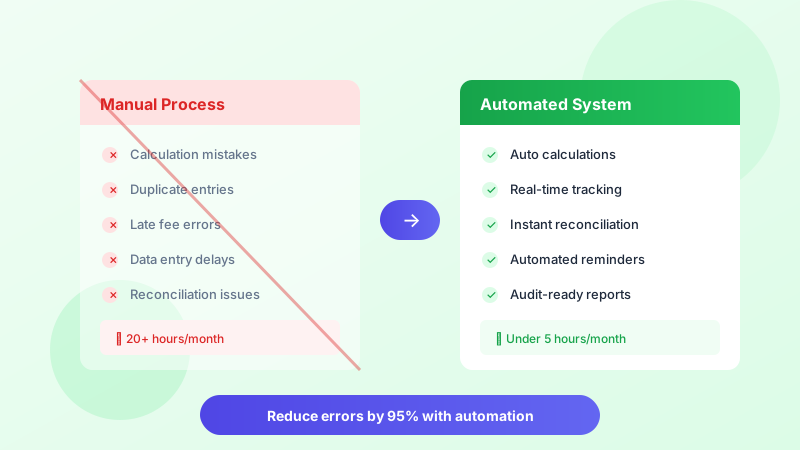
Automated Calculations:
- Maintenance charges computed correctly every time
- Interest calculated consistently
- No manual calculation errors
- Formula-based ensures fairness
Reduced Data Entry Errors:
- Integration with payment gateways eliminates manual entry
- Validation rules prevent invalid entries
- Duplicate detection avoids double counting
#Time Savings
Comparison: | Task | Manual | Digital | |------|--------|---------| | Monthly bill generation | 2-3 days | 1 hour | | Payment recording | Continuous | Automatic | | Bank reconciliation | 1 day | 30 minutes | | Annual statement prep | 1 week | 1 day | | Audit preparation | 2 weeks | 2-3 days |
#Enhanced Transparency
Real-Time Access:
- Members can view their ledgers anytime
- Committee can monitor finances remotely
- No waiting for monthly reports
- Instant answers to queries
Audit Trail:
- Every entry traceable to user and timestamp
- Changes logged and visible
- No manual alterations possible
- Tamper-evident records
#Better Decision Making
Analytics and Reports:
- Collection trends visible at a glance
- Expense patterns identifiable
- Budget performance tracked
- Cash flow projections possible
#Common Accounting Mistakes
#Mistake 1: Mixing Personal and Society Funds
Problem: Committee members use personal accounts for society transactions or vice versa.
Consequences:
- Audit complications
- Tax issues for individuals
- Accountability questions
- Legal liability
Solution: All society money must flow only through society bank accounts. Period.
#Mistake 2: Inadequate Documentation
Problem: Payments made without proper bills, quotations, or approvals.
Consequences:
- Audit objections
- Tax disallowance
- Fraud suspicions
- Personal liability for committee
Solution: No payment without documented approval and supporting invoice. No exceptions.
#Mistake 3: Ignoring TDS Requirements
Problem: Not deducting or depositing TDS on contractor and professional payments.
Consequences:
- Interest and penalties from tax department
- Disallowance of expenses
- Personal liability for committee members
- Prosecution in extreme cases
Solution: Understand TDS obligations, deduct where required, deposit on time, file returns.
#Mistake 4: Informal Cash Handling
Problem: Collecting maintenance in cash and not depositing promptly.
Consequences:
- Theft and misappropriation risk
- Record-keeping failures
- Audit issues
- Member disputes
Solution: Minimize cash collections. When unavoidable, deposit within 24 hours with proper receipt.
#Mistake 5: Not Reconciling Regularly
Problem: Bank statements not matched with books monthly.
Consequences:
- Errors go undetected
- Fraud opportunities
- Year-end surprises
- Audit difficulties
Solution: Reconcile every bank account every month without fail.
#Mistake 6: Ignoring Statutory Deposits
Problem: Not transferring required amounts to sinking fund or reserve fund.
Consequences:
- Violation of bye-laws
- Audit qualification
- Insufficient funds for major repairs
- Member disputes
Solution: Automate fund transfers based on bye-law requirements.
#Mistake 7: Poor Receivables Management
Problem: Not following up on defaulters, writing off without approval.
Consequences:
- Collection rates decline
- Honest members subsidize defaulters
- Cash flow problems
- Legal complications in recovery
Solution: Systematic follow-up process, committee review of all write-offs.
#Implementing Digital Accounting
#Preparation Steps
-
Document current processes:
- How is billing done today?
- What payment methods are accepted?
- Who does what in accounting?
-
Clean up data:
- Reconcile all member balances
- Clear suspense entries
- Correct known errors
-
Select appropriate software:
- Match features to requirements
- Consider integration capabilities
- Evaluate support and training
#Migration Process
Data migration:
- Opening balances for all members
- Bank account balances
- Outstanding payables
- Fund balances
Parallel running:
- Run both systems for 2-3 months
- Reconcile results
- Build confidence before cutover
Training:
- Committee members on administration
- Accountant on day-to-day operations
- Residents on self-service features
#Post-Implementation
Regular reviews:
- Monthly reconciliation
- Quarterly variance analysis
- Annual audit preparation
Continuous improvement:
- Gather feedback
- Utilize more features over time
- Update processes as needed
#Frequently Asked Questions
#Does our society need to pay GST?
It depends on turnover and charge levels. Societies with annual turnover above Rs. 20 lakh may need registration. Maintenance above Rs. 7,500 per month per flat may attract GST. Consult a tax professional for your specific situation.
#Who is personally liable if there are accounting issues?
Committee members can be held personally liable for fraud, negligence, or statutory non-compliance. Following proper procedures, maintaining documentation, and getting regular audits protects individuals.
#How long should we retain accounting records?
Generally, retain records for at least 8 years. Longer if there are ongoing disputes or legal matters. Digital storage makes long-term retention easier.
#Can society accounting be done on Excel?
For very small societies with simple transactions, Excel can work. For larger societies or complex operations, dedicated accounting software significantly reduces errors and effort.
Ready to Transform Your Society Management?
Connected Hood makes managing your residential community effortless. From visitor management to billing automation, experience the difference.
#Conclusion
Society accounting does not have to be complicated, but it must be done properly. Following compliance requirements, implementing best practices, and leveraging digital tools transforms accounting from a burden into a straightforward administrative function.
The key principles are simple: document everything, segregate duties, reconcile regularly, and maintain transparency. When these principles are followed, audits become smooth, members trust the committee, and volunteers do not dread taking on financial responsibilities.
If your society is struggling with accounting, start by addressing the most critical gaps. Implement proper controls, consider digital solutions, and seek professional help for complex compliance matters. Your future committee members will thank you.
Need help streamlining your society's accounting? Connected Hood offers comprehensive financial management features designed for Indian housing societies—from automated billing to audit-ready reports. See how we can simplify your society's finances.
Related Articles
How to Reduce Manual Billing Errors in Housing Societies
Top 10 Must-Have Features in a Society Management App
Getting Started with Society Billing: A Complete Guide